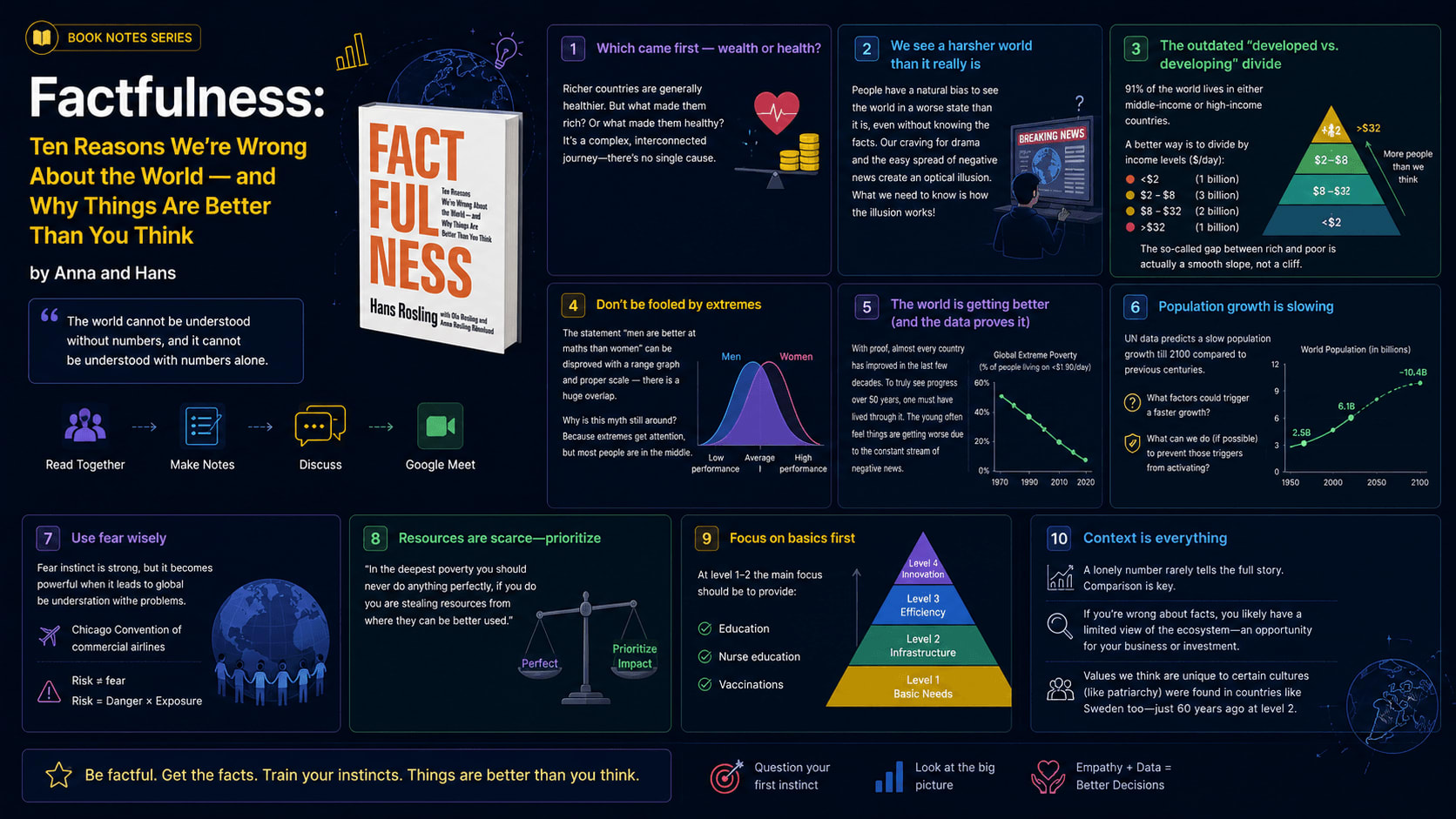
We Started a Book Club
We recently started a Book Club at Wingify where we read one book every month, make notes individually, and later discuss our thoughts over a Google Meet. These aren't traditional book reviews or chapter-by-chapter summaries—they're simply my personal notes and key takeaways written in a gist-style format.
The first book we picked was Factfulness by Hans Rosling, along with Ola Rosling and Anna Rosling Rönnlund.
The central message of the book is simple: the world is far better than we thin but our instincts often convince us otherwise.
Through data, historical trends, and stories from around the world, the authors challenge many common misconceptions and teach us how to think more objectively.
Key Ideas & Takeaways
Are Rich Countries Healthier, or Does Wealth Create Health?
One question that immediately caught my attention was:
Are richer countries healthier, or did becoming healthier make them rich?
It made me think about how deeply connected health, education, productivity, and economic growth are. Wealth improves healthcare, but a healthier population is also more capable of building wealth. It's not a one-way relationship but a reinforcing cycle.
Why We Think the World Is Getting Worse
Most people genuinely believe the world is in a terrible state, even when the data suggests otherwise.
The book argues that this isn't because people are ignorant or uninformed. Instead, our brains are naturally drawn toward dramatic events. News organizations report disasters, conflicts, and crises because they capture attention, while gradual improvements rarely become headlines.
The result is an optical illusio we confuse what is most visible with what is most common.
Understanding this bias is the first step toward seeing the world more accurately.
Rethinking "Developed" and "Developing" Countries
The traditional labels of "developed" and "developing" countries no longer reflect reality.
According to the data presented in the book, around 91% of the world's population lives in middle-income or high-income countries.
Instead of thinking in two separate categories, the authors suggest viewing the world across four income levels:
* Level 1: Less than $2 per day (~1 billion people)
* Level 2: $2–$8 per day (~3 billion people)
* Level 3: $8–$32 per day (~2 billion people)
* Level 4: More than $32 per day (~1 billion people)
Rather than a huge gap between rich and poor, the world looks much more like a continuous slope.
The Danger of Generalizations
One example the book uses is the statement:
"Men are better at mathematics than women."
When viewed properly using distribution graphs instead of averages, the overlap between men and women is enormous.
Extreme cases exist, but they represent only a tiny fraction of the population. Making broad conclusions based on those extremes ignores where the vast majority of people actually lie.
It was a great reminder that averages and distributions tell very different stories.
Progress Is Easier to Miss Than Decline
Almost every country has improved dramatically over the past several decades.
Health has improved.
Education has improved.
Child mortality has fallen.
Life expectancy has increased.
However, these changes happen gradually over decades rather than overnight.
Someone who has personally witnessed fifty or sixty years of change may naturally appreciate this progress, while younger generations often see only today's problems because bad news spreads much faster than good news.
The world has improved more than it appears.
Population Growth Isn't What Most People Think
The UN projects that population growth will continue but at a much slower pace throughout this century.
Instead of asking whether population will grow, I found myself asking a different question:
What could change these projections?
What factors could accelerate population growth beyond expectations? And if those factors are undesirable, what actions today could prevent them?
The book encourages thinking beyond current numbers and considering the systems behind them.
Fear vs Risk
Fear is one of our strongest instincts but fear isn't always a bad thing.
When directed properly, fear can encourage collaboration and innovation. The Chicago Convention, which helped standardize international commercial aviation, is one example of people working together to reduce shared risks.
One idea that particularly stood out was:
Risk ≠ Fear
Instead,
Risk = Danger × Exposure
This simple distinction changes how we evaluate many situations.
Doing the Most Good with Limited Resources
One quote that stayed with me was:
"In the deepest poverty you should never do anything perfectly. If you do, you are stealing resources from where they can be better used."
At first this sounds harsh.
But the underlying principle is about maximizing impact.
When resources are extremely limited, helping more people adequately is often better than helping a few people perfectly.
Numbers Need Context
Another memorable lesson:
"The world cannot be understood without numbers, and it cannot be understood with numbers alone."
Statistics are essential. But numbers without context can easily mislead.
The best decisions come from combining data with human understanding.
Priorities for the Poorest Communities
For countries and communities living at income Levels 1 and 2, the book highlights several interventions that consistently create the greatest impact:
* Education
* Training nurses and healthcare workers
* Vaccination programs
These foundational investments improve health, productivity, and future economic development simultaneously.
Never Trust a Single Number
A single statistic rarely tells the complete story.
Numbers become meaningful only when compared across time, regions, or different groups.
Without context, even accurate numbers can lead to incorrect conclusions.
This idea applies well beyond economics—it is equally relevant in business, investing, software engineering, and everyday decision-making.
Wrong Assumptions Can Hide Opportunities
One thought that resonated with me was this:
If we're wrong about how the world actually works, then we're probably overlooking opportunities that exist because of those incorrect assumptions.
Whether it's investing, starting a business, or building products, having a more accurate understanding of the ecosystem often reveals opportunities that others miss.
Social Change Is Universal
Many values that people assume are unique to certain cultures or religions are often linked more closely to economic development.
For example, the book points out that societies like Sweden also experienced strong patriarchal norms when they were at lower income levels around sixty years ago.
Social values evolve alongside improvements in education, healthcare, and economic prosperity.
Final Thoughts
My biggest takeaway from Factfulness wasn't a single statistic. It was realizing how often our instincts are wrong.
We naturally divide the world into simple categories, focus on dramatic events, fear unlikely risks, and overlook slow but meaningful progress. The book teaches us to pause, question our assumptions, and let evidence guide our conclusions instead.
Whether you're interested in business, investing, public policy, technology, or simply understanding the world a little better, Factfulness offers a valuable framework for thinking more clearly.
I'd highly recommend adding it to your reading list.
Keep reading

You're About to Make a Terrible Mistake by Oliver Sibony
Whether you're making business decisions, investing, hiring, or planning your career, your biggest enemy often isn't a lack of information. It's the biases hidden inside your own thinking.

100M Leads: by Alex Hormozi
How do you consistently get more people interested in what you sell?Most businesses don't have a product problem but an attention problem. You can't sell to people who don't know you exist !